— for those who rent out the room, not for the guest —

A photographer for party and wedding venues

← blog

This article will be useful for party and wedding venues, their coordinators, event organisers and event agencies — for the people who sell the evening.

Every weekend you host an evening worth showing. But it is photographed by an outsider: whether they turn up on time, stay to the end and when the images arrive is out of your hands. And even if the pictures turn out well, they are about the couple or the company, not about the room — and nobody gave you the right to publish them.

You can recommend me without worrying: you give the client my contact and I take it from there. The evening I shoot for whoever booked it also produces the photos you need: the table setting before the guests arrive, the room in evening light, your suppliers at work. They are yours, with no extra line on the invoice.

I have worked as a photographer for 15 years and done more than 3,000 shoots: weddings, company parties, anniversaries, birthdays, themed parties and club nights, from small gatherings to parties with up to 1,000 guests.

The bride and groom forehead to forehead in the dim light of the venue
01

A photographer you will be glad to recommend

When you recommend a supplier you are vouching for them. So the important part is not the price but that the result is the same every time: I arrive early, stay the whole evening, do not drink on the job and do not disappear in the middle of the programme.

I am easy to be around — guests relax, and the pictures come out alive instead of posed.

15 years as a photographer and more than 3,000 shoots in every possible condition: dark clubs, bright conference halls, churches without flash, evenings outdoors. Your client gets a result you can stand behind — and next time they ask you, not Google.

Every timethe same result, not pot luck
Experience15 years, 3,000+ shoots
The couple walking down the petal-strewn aisle as the guests stand and applaud
02

You will not have to manage me

All you do is pass on my contact or introduce us. After that it is on me: I find out the format of the evening, the number of guests and the timing, quote a price, book the date, turn up and deliver the photos to the client.

You do not become my project manager: no reminding me about the date, no answering to the client for my deadlines.

And zero work for your staff on the night itself: I book myself in, arrive with my own gear and need neither a table nor a dedicated contact person.

From youthe client’s contact or an introduction
After thatclient, timing, shoot and delivery are on me
The groom answering into a microphone, the host with a mic in the foreground
03

The coordinator’s best friend

I do not need much: bring me up to speed. Introduce me to the client or give me a simple description of the event — that is already enough for me to work the evening without bothering you with questions.

If the job is a particular one, a running order or a shot checklist helps: who must be in the pictures, when the key moments happen, what must not be missed. If such a document exists, send it; if not, a conversation will do.

I try not to miss anything, and it usually works. But if the coordinator feels better keeping an eye on the shoot, they are welcome to stay with me all evening — it does not get in my way.

And I stay out of the service team’s way: I never stand between a trolley and a table, I do not hold up the food to get a shot, and I move no laid tables.

The minimuman introduction or a short brief
If you have onea running order or a shot list
Wine being poured into the glasses at the laid table with a floral centrepiece
04

Content for your own channels

At every party I shoot a separate series about the house rather than the guests — bonus images that are not part of the client’s booking. Before the guests: the facade and the entrance, the hall with its doors open, the finished table setting, the decor, the bar. Then the evening — the catering and the food as it is served, the kitchen and the staff at work, the bartender behind the bar, the DJ and the band on stage, the whole room full of people in a wide shot, and other moments.

One honest note about the format: this is reportage, not studio work. A plate just placed in front of a guest will not become a menu photograph — but for social media and the website it is exactly the right material, because it shows the house in real use instead of staged for a catalogue.

Photographedfacade, hall, table setting, catering, bar, DJ, band
Formatreportage for social media
A ring in an open box among the evening decor: black tulle and red roses
05

Usage rights

From my side: use the images in your own marketing — on your website, in social media, in proposals and in presentations. That is included, and you do not have to ask each time.

What I cannot decide for you is the people in the frame and whoever booked the evening. If a couple or a company does not want the images published, they are not published — that is the client’s call, not mine. Candid guest shots are always taken after asking, a sign at the entrance saying the evening is being photographed settles most of it in advance, and for closed events I work under a non-disclosure agreement.

From meyes — use the images freely
Publication decided bythe guests and the client
Closed eventsNDA on request
A florist in gloves arranging roses in a vase, the room behind in coloured light
06

Shared content and collaborations

I do not photograph only the client. The florist, the pastry chef, the decorator, the catering and the kitchen, the bar, the DJ and the band all get their images from the same evening — and so do the ones the client brought along, like the make-up artist or the car hire.

Then comes the actual point of the collaboration. The material goes out on my side — Instagram with 5,000+ followers and a site read in four languages with thousands of views a month — with the partners tagged. Your venue is seen by people choosing where to hold their evening, and your guests see a photographer. It works both ways.

I am in favour of arrangements like this: a recurring partner is worth more than a one-off booking. If you already do this with your other suppliers, I fit into it easily.

Instagram5,000+ followers
Websitefour languages, thousands of views a month
A large hall with laid tables under blue parasols, seen from the balcony
07

The photographer on your invoice?

I am not asking you to put me on your invoice. Recommending me is enough: the client pays me directly, you avoid my bookkeeping and do not have to answer for my delivery times.

If you would rather sell the evening as one package — menu, staff, entertainment, photographer — that works just as well. Then I invoice you and your mark-up is yours to set; my terms are published on the site, so the package can be calculated straight from them.

If you would rather have a commission or some other arrangement, say so — I will follow whatever you already do with your other suppliers.

Simplestyou recommend, the client pays me
If you preferI invoice you, the mark-up is yours
Or your modela percentage — as with your other suppliers
A countryside venue at dusk: warm light in the windows and guest silhouettes inside
08

The first evening on your terms

Nobody recommends a photographer they have never seen work. So the first evening at a venue or agency I have not worked with before can look however you want it to.

For nightclubs: I photograph the evening and send you the finished set. You look through it calmly and buy the images only if you like what you see. If you do not, it costs you nothing — we have both spent one evening and now know more about each other.

For party venues, wedding venues and agencies: tell me what suits you. I am happy to work the way you already work with your other suppliers.

Tell me which evening is next in your calendar and how you prefer to do business, and I will come back with a concrete proposal.

Nightclubssee the images first, then buy — or not
Venues and agenciesyou propose the arrangement, I follow it
A red-brick manor with a turret and a glass orangery, lawn and gravel drive
09

I arrive early

I get to the venue before the evening starts — with margin for traffic, parking and getting in. That is not politeness but insurance: a photographer who arrives late never makes up the first hour, and you are the one who has to explain it to the client.

The time before the guests arrive is not idle: I photograph the house from outside, the hall and the table setting — exactly those bonus images — and at the same time see where it will get dark later and where to shoot the speeches and the dance floor from.

By the time the guests walk in I already know the room and am working, not looking around.

On sitebefore the guests, with margin
Time enough forfacade, hall, table setting, light check
Freshly opened oysters on ice with lemon and sauces beside them
10

The kitchen and the catering

The kitchen is the invisible lead of the evening: guests see the plate, never the work behind it. I photograph the chef at work, the final touch before it leaves the counter, and the food as it is carried into the hall.

For the catering team and the kitchen these are pictures they rarely have: their own channels are mostly styled plates, not a kitchen in the middle of a fully booked evening.

I work fast and stay out of the way: nothing is arranged, nobody has to repeat anything, and the service is never held up for a photograph.

Photographedthe chef, the plating, the service
How I workbriefly, without stopping the kitchen
Shot through a window: the couple standing among the guests under string lights, everyone laughing
11

Speeches, toasts and moments

A speech takes a couple of minutes and never comes back. For me it is not a stressful moment: in those two minutes I get to shoot from several angles and look for a frame with something extra in it, rather than just record that the speech happened.

I photograph both the speaker and the faces at the tables: the reactions often say more about the evening than the speaker does. To fit all that in, I only need to know in advance who will speak and in what order.

At a company party those same two minutes are the award or the speech from management; at an anniversary, the tributes to the person being celebrated. Different moment, same work.

In those two minutesseveral angles, speaker and reactions
From youwho speaks, and in what order
The host cutting the themed cake on its own table
12

The cake and the high point of the evening

The cake and the first dance are the two pictures everybody wants afterwards — the client, the baker who made the cake, and you. Together they take a few minutes and require the photographer to already be on the right side of the room.

They are also often the only shots where your venue is seen at its best: the room is full, the lights are down and everyone is looking the same way.

At a company party the equivalent is the award and the team photo; at an anniversary, the cake and the speech to the person being celebrated.

Two certain shotscake and first dance
Neededone minute of warning
The singer and the band on stage with the crowd packed in front
13

The DJ and the cover band

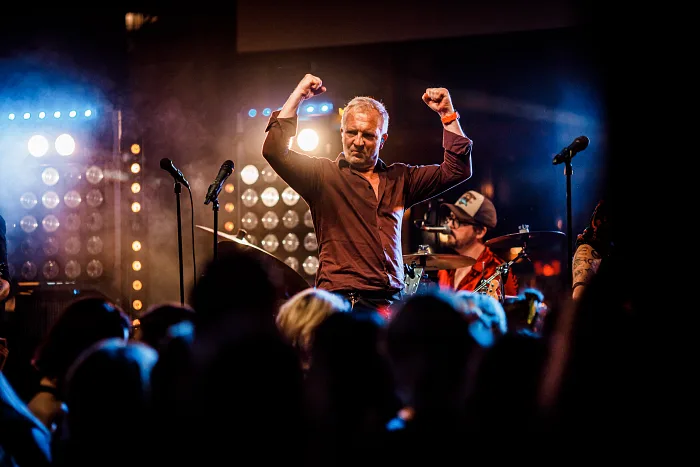
The stage is what sells the next evening: the musicians need images for their own channels, and you need to show that music actually happens at your place. A DJ and a cover band are photographed differently: one person behind the decks in haze and light is one job, five people on stage with instruments and a singer is quite another.

In both cases I take the wide shot — the stage with the crowd in front of it — and the close-ups of whoever is working: hands on the mixer, the singer at the microphone, the drummer. Technically this is the hardest part of the evening: coloured spots, haze, movement and very little light. These are exactly the conditions I started out in, so it is routine rather than a problem.

If you host concerts regularly, the same applies as for stage photography — I wrote about that in the article on concert photography.

Photographedthe stage with the crowd, the artist close up
The lightspots and haze — ordinary conditions
A guest turning on the dance floor while others dance in red light
14

The dance floor and the flash

Late in the evening a party venue is the same environment as a nightclub: dimmed lights, coloured spots, movement and very little light to work with. Without flash the images go soft; with the wrong flash they go flat and the atmosphere disappears. I started out photographing nightclubs five nights a week, so these have been ordinary working conditions ever since, not a problem.

Where the house lights are not enough I work with flash, without blinding the guests or flattening the atmosphere in the image.

Dark venueflash when the light runs out
Club night100–200 images
The couple watching the fireworks over the park late in the evening
15

Fireworks and sparklers

Fountains at the first dance, sparklers in the guests’ hands, fireworks in the yard — the most spectacular images of the evening and the trickiest: a short shutter kills the sparks, a long one blurs the people. I prepare that moment rather than catch it on the run.

While we are at it, I suggest taking the party outside for a couple of minutes: the lit facade at night is a picture of your house that cannot be taken in daylight.

Photographedfountains, sparklers, fireworks
Bonusthe facade at night, with guests
Two guests posing in front of the decorated photo wall at the party
16

A photo booth and a photographer are two different things

A photo booth is entertainment for the guests: they walk up when they feel like it, take their picture and hold it in their hand. What you get back is that the guests had fun — not material about the venue.

The photographer delivers the other half: wide shots of the hall in use, the table setting, the reactions during the speeches, the dance floor. The two do not compete, they complement each other — and both can go into the same package. I also rent out a photo booth, if you would rather have both from one place.

The booththe guest gets a print at once
The photographermaterial for your marketing
Detail of the laid table: dessert, coffee cups and decor in warm light
17

Delivery: what you get and when

Want to see what a whole evening looks like? A themed party, 245 images and a company party, 238 images are in the portfolio — full evenings, not a selection.

Count on roughly 100 finished images per hour photographed. The first images arrive within 24 hours, so both you and the client can post something while the evening is still fresh, and the full album within 7 days.

You get everything in an online gallery to download from — in sizes for web, social media and print.

Volumeabout 100 images per hour
First imageswithin 24 hours
Full albumwithin 7 days
A church wedding: the couple holding candles during the ceremony
18

Beyond the venue

I do not photograph only the evening at your place: the ceremony in a church or town hall, the preparations, the couple session — the whole day. That is a subject of its own, set out on the wedding photography page.

Photographedthe whole day, not just the evening
More on thaton the weddings page
A guest with a snack in hand giving a thumbs up on the dance floor
19

One photographer for every format

Besides weddings and parties that means daytime conferences and seminars, staff portraits, christenings and family celebrations, concerts and club nights.

The bonus for you is simple: one photographer covers every format you host — no separate contact for each kind of evening.

Formatsconferences, portraits, christenings, concerts
One contactfor every kind of evening

Let’s talk about working together

In short, what each side gets. You — a supplier you do not have to keep an eye on. Your client — a full reportage of the evening: first photos within 24 hours, the whole album in 7 days. Your venue — photos of the interior, the table setting and the atmosphere to use in your own marketing.

Send the date, the type of party and roughly how many guests you expect, and you get back a concrete proposal: how many hours are needed, what it costs, and which images you as a venue get out of the evening.

Curious but not ready to recommend me yet — start with one evening on special terms. It is easier to judge a photographer on site than on a website.

If you would rather talk it through first, WhatsApp works just as well.

Discuss a partnership Event photography

Questions venues and coordinators ask

How many hours should be booked?

Minimum 2 hours. A typical party is usually booked for 3–4 hours: reception, seated dinner, speeches and the start of the dance floor. A pure club night often works in 2 hours, because the pictures are taken when the room is at its fullest.

Can we use the images to market the venue?

From my side, yes — website, social media, proposals and presentations are included. What decides it in practice is the guests in frame and whoever booked the evening: if the client objects to publication, the images are not published.

We already have a photo booth — do we need a photographer?

They do different jobs. The booth is entertainment and the guest gets a print immediately; the photographer gives you wide shots of the hall, the table setting, the speeches and the dance floor — the material you can actually use yourselves. They work well together.

What about guests who do not want to be photographed?

Candid guest shots are always taken after asking, and a no is respected without discussion. A sign at the entrance saying the evening is being photographed means most people know in advance.

Our venue is dark in the evening — does that work?

Yes. Darkness, haze and coloured light have been ordinary working conditions for me since the years of club photography. Where the light runs out I work with flash, without blinding the guests or flattening the atmosphere in the image.